Location has been disabled. Location sharing is required to view local results around your location. To use it, you must enable the permission to access the location in the browser settings.
Location has been disabled. Location sharing is required to view local results around your location. To use it, you must share the permission to access the location. To do this, click the lock icon to the left of the address bar and release the appropriate permission.
Location has been disabled. Location sharing is required to view local results around your location. To use it, you need to share the permission to access the location in your device settings under "Privacy and security -> Location services -> Your used web browser (eg. Safari/Chrome/...)".
Location has been disabled. Location sharing is required to view local results around your location. To use it, you must share the permission to access the location. To do this, click the icon to the left of the address bar and then reload the page.
Location has been disabled. Location sharing is required to view local results around your location. To use it, you must share the permission to access the location. To do this, click the icon to the right of the address bar.
King Christian IX. – Europe’s father-in-law
Redaktioneller Artikel
Tourguide
19. December 2025
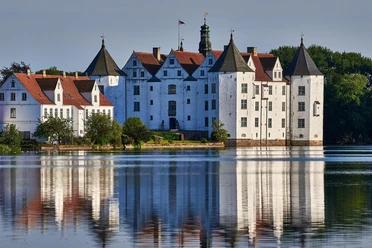
Glücksburg Castle is considered the cradle of European royalty and Christian IX. "Europe’s father-in-law". Since the Danish royal family lacked a successor for the throne, the Glücksburger duke was appointed king in 1863. He had six children, all of whom he skillfully took care of. His son George became King of Greece and his daughter Dagmar tsarina of Russia. To this day, the Glücksburgers are related to the Danish Queen Margrethe II through Christian IX. In 1863, King Christian IX felt compelled to sign the "November Verfassung” (November Constitution), which led to the German-Danish War in 1864. After fierce fighting, Prussia and Austria won, and Denmark had to cede the duchies of Schleswig, Holstein and Lauenburg to Prussia and Austria.